Gmc 270 Engine Serial Numbers
Contents.Divisions Until the mid-1970s, most General Motors brands designed and manufactured their own engines with few interchangeable parts between brands. In the mid-1960s, there were 8 separate families of GM on sale in the USA.By the 1970s, GM began to see problems with their approach. For instance, four different North American divisions (, and ) offered four completely different versions of a 350 cu in V8 engine - very few parts would interchange between the four designs despite their visual similarities, resulting in confusion for owners who naturally assumed that replacement parts would be usable across brands. In addition to these issues and the obvious overlap in production costs, the cost of certifying so many different engines for tightening worldwide emissions regulations threatened to become very costly.Thus, by the early 1980s, GM had consolidated its powertrain engineering efforts into a few distinct lines.
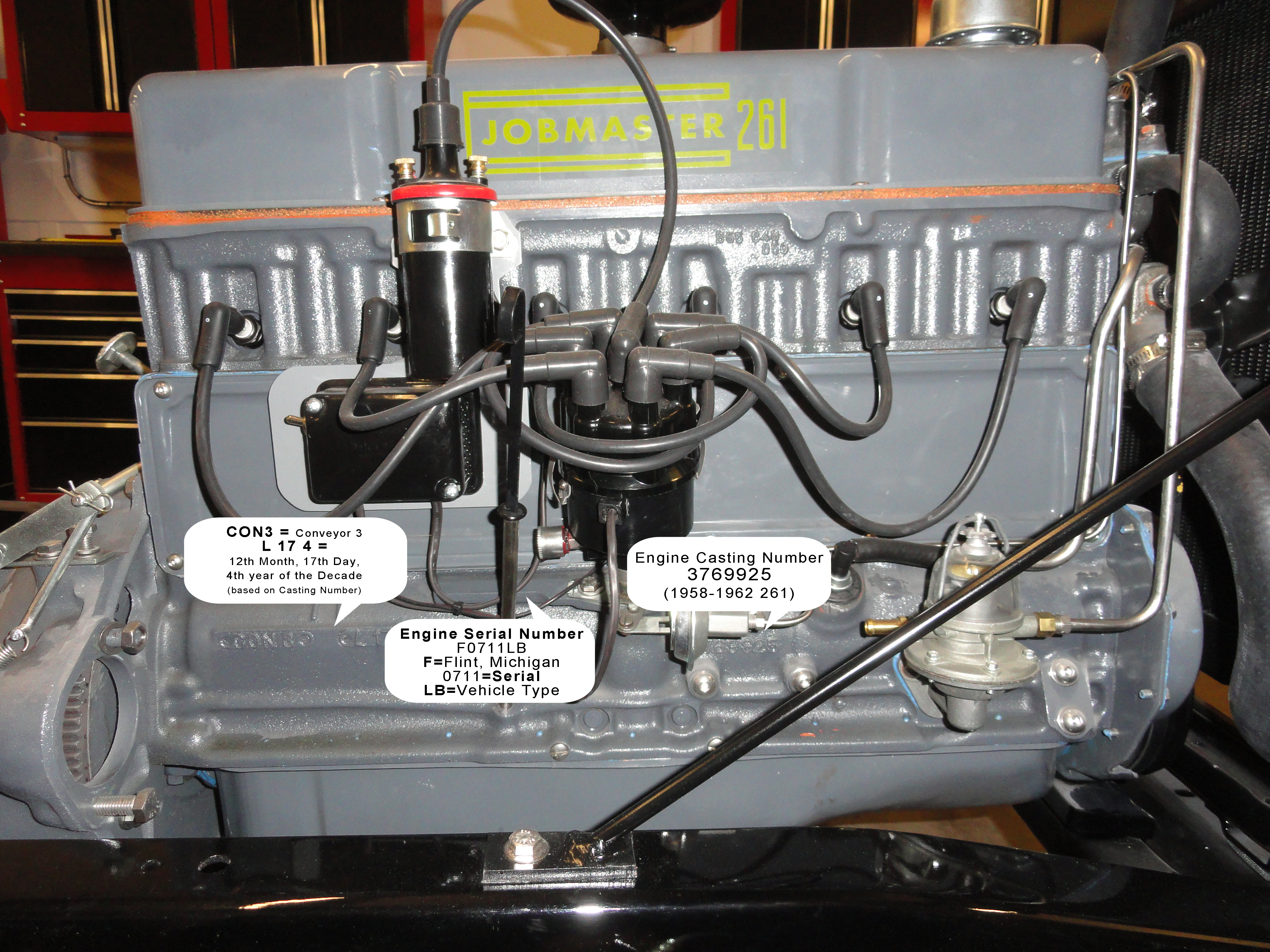
Motor has been replaced with a 270. GMC engine serial numbers are hard to come by/interpret. Here is the only block number I can find. Year: Engine Displacement: Block Casting Number: Cylinder Head Casting Number: Crankshaft Casting Number: Camshaft Casting Number: 39-52: 228: 6107326: 7412.
Generally, North American and European engineering units remained separate, with Australia's Holden and other global divisions borrowing designs from one or the other as needed. GM also worked out sharing agreements with other manufacturers such as and to fill certain gaps in engineering.
Similarly, the company also purchased other automotive firms (including and ), eventually folding their engine designs into the corporate portfolio as well. GM later reorganized its Powertrain Division into GM Global Propulsion Systems, located in.GM's German subsidiary, relies on a range of three-, four- and six-cylinder and engines. A survey of their range shows a reliance on petrol and diesel four-cylinders, and in 2014, there was only one 3-cylinder engine and one 6 cylinder engine in service in Opel's passenger car range.In addition to automobile and truck engines, GM produced industrial engines, which were sold by brands such as,. Most of these engine designs are unrelated to GM's automotive engines.
Automotive gasoline engines Two-cylinder. 1904-1911 World's first production overhead valve engine. 1909 vertical engineThree-cylinder. Buick V6 engine V6. 1960-1978. 1960-2008 (marketed as 'Fireball V6', '3800', 'Dauntless V6' in 1966-1971 Jeeps, and 'Ecotec'). 1977–2013 (derived from the; now marketed as GM Vortec V6).
1979–2010 V6. 1994-2005 L-81 V6 (used in the, and ). 1995–present (used in several models built for GM by Suzuki). 2004–2008 (used in the Saturn Vue). 1998-2002. 2003–2011.
2004–present. 2014–present 'Ecotec3'Eight-cylinder From the 1950s through the 1970s, each GM division had its own V8 engine family. Today, there are only two families of V8 engines in production for road vehicles: the and its derivative. Detroit Diesel Series 92 enginesGM entered the diesel field with its acquisition of the -based in 1930.
Winton's main client was the, a producer of internal combustion-electric rail motorcars. GM acquired Electro Motive at roughly the same time as Winton.A partnership of GM's Research and Development Division and their Winton Engine Corporation delivered their first diesel engines suitable for mobile use starting in 1934. The engines were also sold for marine and stationary applications.
In a 1938 reorganization, Winton Engine Corporation became the GM, and GM's began production of smaller (50–149 cu in (0.8–2.4 l) per cylinder) diesel engines. How to add lot traits sims 4. Locomotive engines were moved under the GM Electro Motive Division (EMD) in 1941, while Cleveland Diesel retained development and production of large marine and stationary engines.Cleveland Diesel was dissolved in 1962 and their remaining production moved to EMD. In 1988, the Detroit Diesel Engine Division was incorporated as an independent company, later acquired by DaimlerChrysler in 2005. Retrieved 2014-02-16. The Truth About Cars. Retrieved 2014-02-16. e (2007-06-05).
Retrieved 2014-02-16. Retrieved 2014-02-16. ^ August 14, 2012, at the. Retrieved 2014-02-16.
DeltaWalker 2 Pro: Compare, Sync, or Merge 3 Files or Folders at Once & Streamline Any Project — Just $29.95! When you’re neck deep in an important project, you often have to juggle multiple files and folders to make sure your message is being communicated correctly. DeltaWalker Pro makes that process easy. Compare files side by side with deltawalker 2 pro for mac torrent. With DeltaWalker 2 Pro you can do it all with up to three files or folders to streamline any project. With one simple, single interface, your files and folders will be displayed for you side by side, speeding up your work, ending the constant flipping back and forth between files. DeltaWalker - world's most advanced and intuitive two- and three-way visual file and folder comparison for Mac OS X, Windows and Linux. Use DeltaWalker to compare (diff) and merge files, compare and synchronize folders.
Retrieved 2014-02-16. Retrieved 2014-02-16. Archived from on 2013-05-29. Retrieved 2014-02-16.
Retrieved 23 May 2014. Missing or empty title=. Retrieved 23 May 2014. Missing or empty title= ; External link in publisher= ; Missing or empty url=. Retrieved 18 July 2014. Retrieved 2014-02-05. Retrieved 2014-02-05.
Retrieved 2014-02-05. Retrieved 2014-12-14.timeline, 1980 to present1980s1990s2000s2010s20789045Atlas3GS-TECFamily 0SGE6Atlas1686Inline4Family II. (1929–1995). (1929–2007). (1919-2013). (2005-2016). (1919–1923).
(1994–1999). (1938–1988). (1994–2003). (1930–2004). (1984–1996). (1953–1968). (1919–1980).
(2001–2019). (1986–2017). (1938–1987). (1949–1969). (1995–2017). (1913–2017).
(2008–2019). (1993–2018). (1953–1963). (1998–2008). (1948–2021). (1985–1997).
(1985–1997). (1987–2003). (DirecWay/DirecPC) (1996–2003). (2016–2020). (1984–2009). (36%, 1990–2002).
(2009–2010). (1933–1948).
(1997–2008). (1931–2017). (1995–2003). (1918–1994). (1989–1996). (1926–2017). (1925–1943).
Small Block Chevy Engine Block Identification General Decoding InformationThis topic can be somewhat confusing, especially with the amount of information available and the interpretation of it.The primary pieces of information you'll decode are the Engine Code and Partial VIN. You can decode the casting number. And you can check dates.The engine code and partial vin # will accurately nail down whatever the thing is rather quickly, and the other information will fall into line with that.To- for decoding engine codes.This page has basic information on it, but it's a portion of the Small Block Chevy numbers information. The Engine Code page is where this topic is further detailed.' Numbers Matching'This is my opinion, and the generally accepted norm:When people say 'It's numbers matching' - what they mean is the engine (or other component, i.e the transmission) can be MATCHED to the vehicle it wasoriginally used in.
This match is done via the PARTIAL VIN stamp on the component. The partial VIN will match the vehicles VIN.
If it does - it's 'numbers matching',otherwise - it's not. End of story.Some folks use these terms loosely, or will say 'numbers correct' or something to that effect. But numbers correct is not numbers matching. Again, it either matchesor it doesn't. If it doesn't match - is it correct?Numbers matching is important when you're trying to decode a Z28 or Super Sport where the VIN won't identify the vehicle as such. You need to decode the engineand see if it matches the vehicle, and if the code signifies Z28 or SS equipment.Lastly, in extreme cases, you'll want to verify the numbers stamped onto the component were the ones stamped into it originally and aren't restamped.The point of this article is to help you figure out how to decode stuff.All engines are stamped with an engine ID code, consisting of assembly plant code, productiondate and suffix code.
V8 codes are stamped on a pad just forward of the right side (passenger)cylinder head. 6 cylinder engines are stamped on the passenger side of the block behind thedistributor.The engine date must precede the car build date, otherwise something is amiss. Some enginemachining operations (decking) will obliterate the engine ID.Engine ID Code Example: V0101CLJ - (V = Plant, 01 = Month, 01 = Day, CLJ = Engine Suffix Code)Another example: T0830CTY - (T = Tonawanda, 08 = August, 30 = 30th day, CTY = 1970 396 Camaro, 375 hp, 11.0:1, TH400)CodeEngine PlantCodeEngine PlantFFlint (Motor)SSaginaw ServiceHHydramaticTTonawandaKSt. Catherines, OntarioVFlint (Engine)(McKinnon Industries Canada)MGM of MexicoThe vin code format is stamped onto most engines. The format consists of divisional identificationnumber, model year, assembly plant designation and vehicle serial or sequence number.In 68-69 model cars, the serial (VIN) number of the car the engine was installed in is stampednext to, or under the engine code ID.Starting in 1970, the serial number is stamped either above the oil filter, somewhere on the blockpad (in front of the cylinder head), or on the transmission flange somewhere. Chevrolet issuedtechnical service bulletins to indicate which engines were to recieve a vin stamp, so who knows whatcould have happend (or not happened).VIN code format Example: 13N100001(1 = Chevrolet, 3 = 1973, N = Norwood, 100001 = Production sequence of vehicle VIN)For a list of assembly plants,On some Saginaw blocks, intakes and exhausts a 'clock' was cast into the block.The clock is a circle of 10 dots, one dot for each hour of a shift (usually 10 hour shifts).An arrow points to the beginning of the shift an another dot outside the circle indicates whattime of day the cast part was made.
Anyways, that's what that circle thing is (if you happen tosee it on something).Small block casting date is located on driver side rear of block on flange forward ofbellhousing. Big block on the right side of engine above the oil pan rails.Casting Date Example: E038 - (E = Month, 03 = Day, 8 = Last digit of model year (1978)).Month: A = Jan, B = Feb, C = Mar, D = Apr, E = May, F = Jun, G = July, H = Aug, I = Sep, J = Oct, K = Nov, L = Dec. While 6 different bore size blocks have been produced, the small block engine can be classified into 3 bore sizes and 3 main bearing sizes. 283 blocks (3.875' bore, 2.3' main), 302/327/350 blocks (4' bore, 2.3' or 2.45' mains), and 400 blocks (4.126', 2.65' mains). In 1968 the main bearing saddles were increased in size from 2.3' to 2.45'.CIDYearBoreMain Cap262 bolt ONLY2671979 - 813.5002 bolt ONLY3051976 - 963.7362 bolt ONLY3071968 - 733.8752 bolt ONLY3271968-694.001 (2.3' main)2 bolt3501968-884.001 (2.3' main)2 bolt26519944.001 (2.45' main)2 bolt3021968-694.001 (2.45' main)4 bolt3501968-964.001 (2.45' main)4 bolt4001970-724.126 (2.65' main)4 bolt4001973-804.126 (2.65' main)2 boltNotes: 2 bolt ONLY means just that. Otherwise 2 or 4 bolt can mean either design.Notes (for below): 'High Power' is the maximum rate HP this block was used for, 'Low Power' is the lowest rated horsepowerRPO engine the block was used in. 'Main Caps' is the number of bolts holding the cap.
A 'two-bolt' main, or afour-bolt main. Four bolt main blocks are desirable in high performance applications becausethe extra strength of the additional bolts keeps the bottom end rigid and less prone to failure.However, a properly prepared 2 bolt main engine will work just fine (often times you'll lose arod bolt before you break a crank because it's 'only' a 2 bolt main).YearsCastingCIDLow PowerHigh PowerMain CapsComments.